

Overview
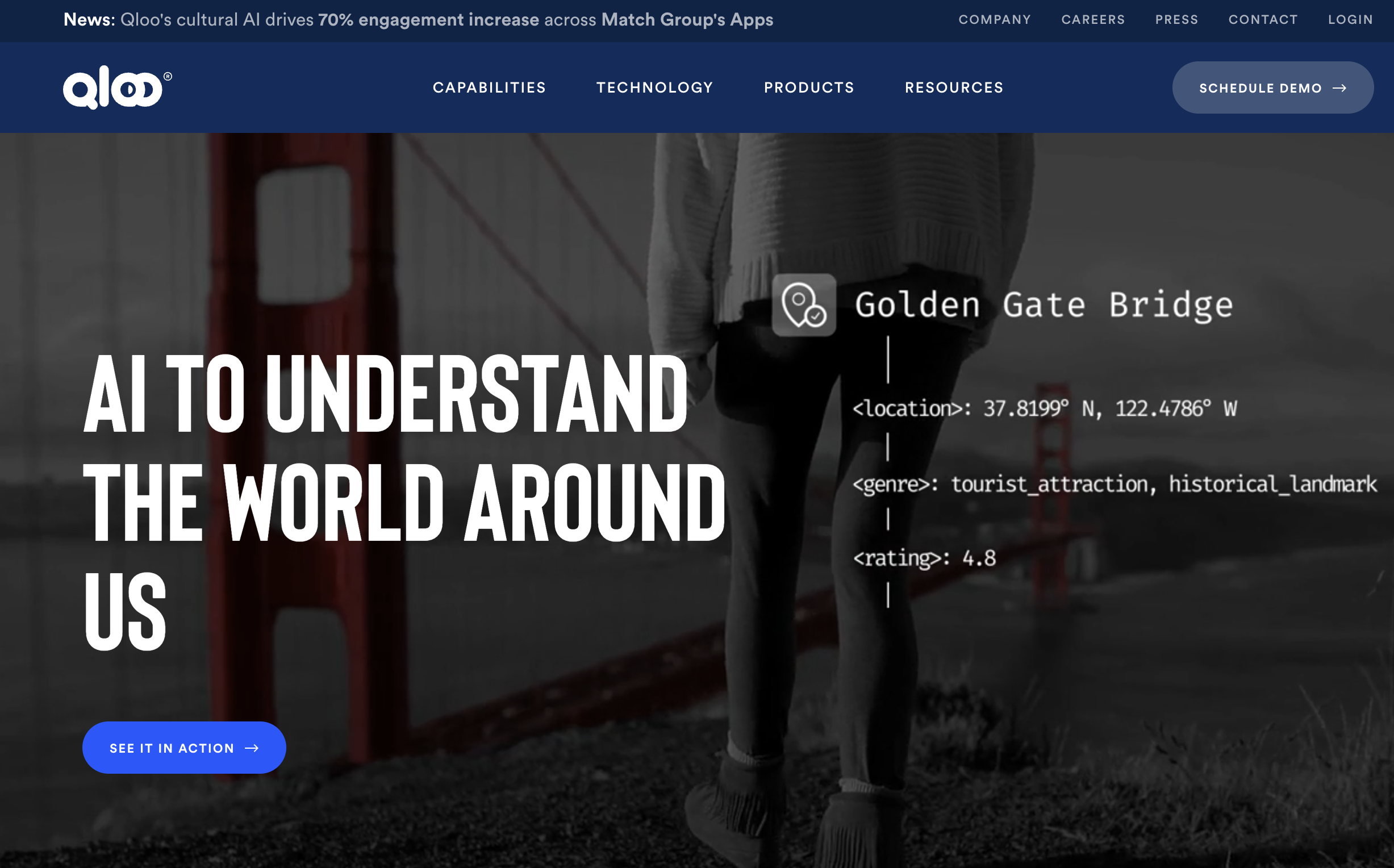
- Predict what your audience will love next by using Qloo's Taste AI engine, which maps hidden connections between seemingly unrelated consumer interests to forecast future preferences across cultural domains.
- Understand exactly why consumers prefer certain products, brands, or content through the Cultural Intelligence Layer that analyzes trillions of behavioral signals and multi-dimensional taste vectors.
- Build a complete cultural profile of any audience beyond demographics by leveraging Qloo's audience intelligence, which reveals affinities for music, media, brands, destinations, and experiences.
- Deliver instant, private personalization on any device with on-device AI that deploys compact models directly on phones, tablets, and edge devices without sending user data to the cloud.
- Transform raw customer data into actionable preference intelligence by using Qloo's data licensing feature, which enriches datasets with structured cultural entities and cross-domain connections.
- Increase audience engagement and conversions by personalizing content, recommendations, and experiences based on predicted consumer tastes in entertainment, media, banking, and retail.
- Make informed, data-backed business decisions with analytical reports that provide a clear map of human taste and consumer behavior patterns across diverse cultural domains.
Pros & Cons
Pros
- Predicts consumer preferences
- Cultural Intelligence Layer
- Analyzes consumer behavior
- Operating extensive catalog
- large anonymized consumer behavior database
- Insights into audience profiles
- Cross-industry applicability
- Data licensing
- Audience intelligence
- No PII required
- Near-instantaneous private taste intelligence
- Comprehensive cultural profile
- Preference identification
- Personalizes marketing strategies
- Powerful recommendation capabilities
- Cross-domain recommendations
- Deeper audience insights
- Taste analysis
- Entity Catalog of 3.7B+
- Behavior & Sentiment database of 10T+
- Analyses consumer affinities
- Resonant business strategies
- Real-world preference capture
- Improves ad targeting
- Enriches first-party customer data
- Overcomes cold start challenges
- Personalizes language models outputs
- Autonomous agent realization
- On-device model deployment
- Campaign planning support
- Structured metadata and relational taste
- Predicts consumer tastes
- Can be integrated to any system
- Structured entity catalog
- Mapped behavioral signals
- Continuous data update
- Granular taste analysis
- Provides cultural contexts
- Offers cross-domain connections
- Transforms raw data to actionable intelligence
- Compliant with GDPR, CCPA
- Offers proprietary taste models
Cons
- Extensive data catalog necessary
- Requires large consumer behavior database
- Cultural domains focused
- Limited to specific industries
- Personalization strategy requires detailed inputs
- Potentially high system integration
- Heavy reliance on taste intelligence
- No PII can limit granularity
- Cultural analysts needed
- No mention of scalability
Reviews
Rate this tool
Loading reviews...
❓ Frequently Asked Questions
Qloo is an advanced Artificial Intelligence tool that specializes in the prediction of consumer preferences across varied cultural domains. It operates the world's largest catalog of notable individuals, locations, items, and interests, powered by its Cultural Intelligence Layer. Qloo's database includes anonymized consumer behavior data for insights into audience profiles and cultural affinities. Businesses such as Michelin and Netflix utilize Qloo to enhance growth through superior personalization.
Qloo predicts consumer preferences by analyzing and mapping consumer behavior patterns utilizing its Cultural Intelligence Layer. This layer uses an extensive catalog of notable people, places, things, and interests, and an anonymized consumer behavior database, to generate audience profiles and deduce their cultural affinities. It also identifies the hidden connections between seemingly unrelated interests, providing a deeper understanding of consumer behavior.
Qloo serves a variety of industries and sectors, including but not limited to the entertainment industry, the media industry, the banking sector, the retail industry, and many more. It provides these sectors with a clear map of human taste, consumer behavior analysis, and targeted personalization, thus aiding them in making informed business and customer-related decisions.
The Cultural Intelligence Layer of Qloo is a dedicated system designed to provide insights into the tastes and preferences of humans by analyzing and mapping consumer behavior patterns. This function is achieved by operating an extensive catalog, which includes notable people, places, things, and interests, thereby providing a deep understanding of diverse cultural domains.
Qloo's on-device AI delivers near-instantaneous private taste intelligence on any device. It deploys compact models directly on phones, tablets, and edge devices for instant personalization without relying on the cloud. This technology allows for culturally aware experiences while ensuring user data never leaves the device, ensuring privacy and leading platform compliance.
Qloo's consumer behavior database contains largely anonymized and permissioned behavioral signals that cover areas including transactions, interactions, sentiment, and location patterns. These signals, correlated with Qloo's entity catalog of cultural entities, provide a rich source of data for understanding and predicting customer preferences.
Some of Qloo's key features include the Cultural Intelligence Layer, an extensive catalog of cultural entities, an anonymized consumer behavior database, on-device AI for private taste intelligence, and extensive audience intelligence. It also provides features for data licensing, integrating taste intelligence into any system, and analytical reports on cultural intelligence.
Qloo analyzes and maps consumer behavior patterns through its proprietary Taste AI engine. Leveraging terabytes of first-party and permissioned behavioral signals, Qloo maps the relationships between billions of cultural entities. The resultant multi-dimensional taste vectors help in predicting preferences, unveiling hidden affinities and transferring knowledge from one domain to another.
Audience profiling in Qloo is handled through its suite of audience intelligence applications. Qloo reveals the full spectrum of an audience's cultural affinities, including their favored music, media, brands, destinations, and experiences. The resulting insight allows businesses to create strategies that resonate with the audience on a deeper level.
Qloo plays a significant role in the entertainment and media industry by predicting the tastes and preferences of audiences. Its cross-domain recommendations allow for the connection of preferences across culture, media, entertainment, etc. Therefore, media and entertainment businesses can recommend content based on a deeper understanding of a consumer's taste across different domains.
Qloo provides businesses with the tools to manage personalization strategies by understanding why consumers like what they like. This insight, powered by the mapping of hidden connections between unrelated interests and a full cultural profile of the audience, allows businesses to personalise their offerings based on individual consumer's tastes and preferences.
The increase in audience engagement with Qloo is driven by its ability to deliver personalized and relevant content, recommendations, or experiences that resonate with the audience's cultural affinities, ensuring more meaningful and engaging interactions.
Data licensing in Qloo involves the enrichment of raw customer data or third-party data sets with Qloo's structured cultural entities. It transforms raw data into actionable intelligence by adding cultural context, preference signals, and cross-domain connections.
Taste Intelligence in Qloo refers to the structured understanding of real-world preferences via analyzing trillions of real-world behavioural signals. It helps to predict what people like, understand why people like what they like, and also anticipate what they'll want next.
Qloo's AI technology aids marketing strategies by providing a full cultural profile of any audience and by predicting future consumer preferences. The additional insights into why consumers like certain things allow businesses to tailor their marketing strategies for more effective personalization, engagement, and conversions.
The cultural profile provided by Qloo gives businesses a holistic view of their audience beyond traditional demographics and purchase history. Businesses are able to understand their audience's cultural affinities including their music, media, brands, destinations, and experiences. This knowledge helps to inform, target and personalise marketing and business strategies.
In the Banking and Finance sector, Qloo helps by providing deep insights into the preferences and behaviors of their customers, thereby allowing for custom-tailored financial products and services that resonate with their customers’ preferences.
In the retail industry, Qloo aids by mapping consumer preferences and tastes. It provides insights into why customers prefer certain products over others, enabling retail businesses to personalize product recommendations, thereby enhancing the shopping experience and increasing customer loyalty.
Yes, Qloo's proprietary Taste AI™ engine has been designed and trained to predict what an audience will love next. It does this by mapping hidden connections between seemingly unrelated customer interests and behaviors. These intricate patterns unlock a level of understanding no traditional survey or analytics tool can provide.
Yes, Qloo offers a demo to explore its advanced features and capabilities. Businesses can schedule a demo to give their AI a structured understanding of what people want, thereby aiding their decision-making process in a more informed and data-backed manner.
Pricing
Pricing model
No Pricing